
Why Did That Shipment Cost So Much?
The hidden factors behind parcel pricing and how to take control of them
When brands look at a parcel invoice, it’s tempting to assume the biggest factor is simple:
How much did the box weigh?
In reality, that’s only one piece of the puzzle.
Whether you’re shipping with FedEx, UPS, or OnTrac, there are several key factors that determine what you pay. Understanding them can help explain invoices, improve packaging decisions, and even uncover opportunities to negotiate better rates.
1. Where is it going? (Zone)
The first major factor is distance.
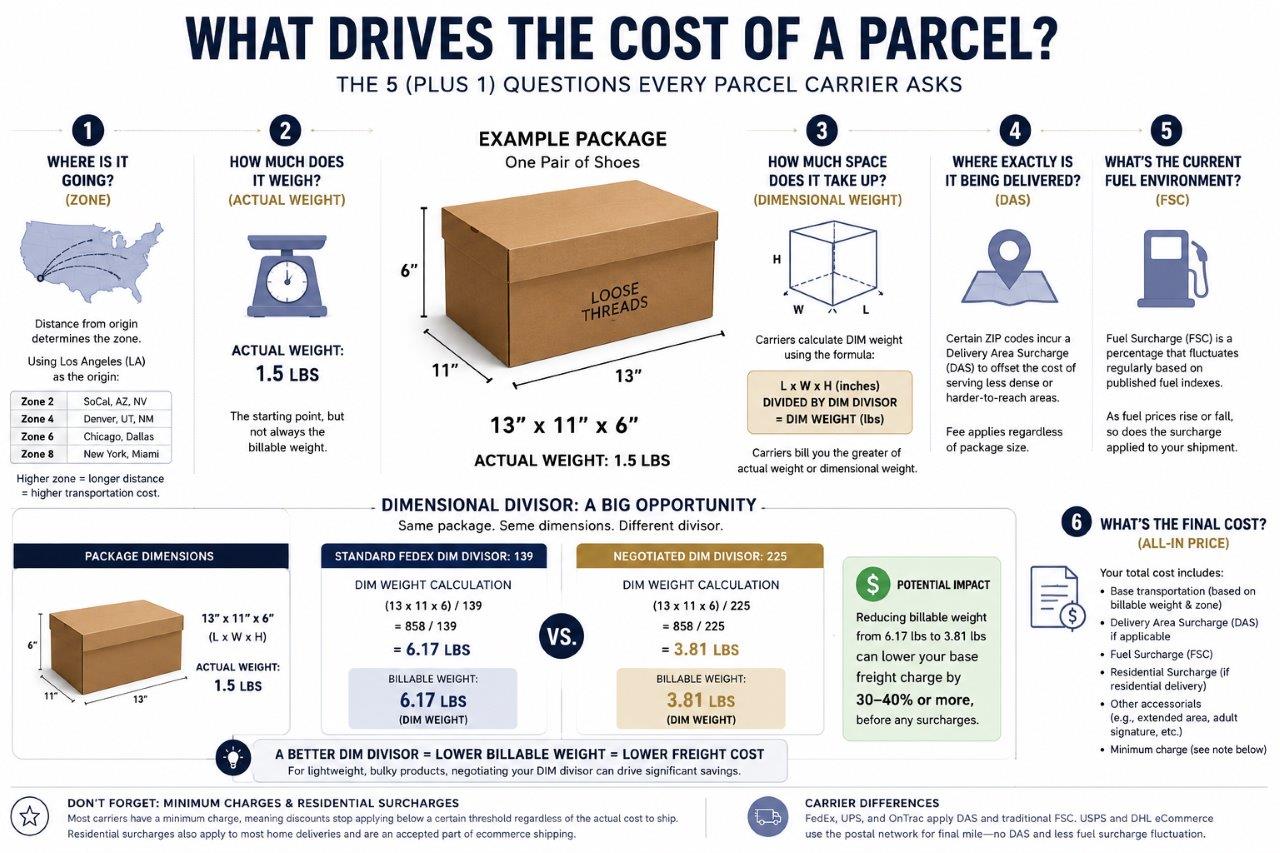
Using Los Angeles as an example origin, a shipment staying within Southern California might travel as a Zone 2 package. Send that same box to New York and it could become a Zone 8 shipment.
Generally speaking:
- Lower zone = shorter distance = lower transportation cost
- Higher zone = longer distance = higher transportation cost
2. How much does it weigh?
Seems obvious enough.
If your package physically weighs 3 pounds, carriers start with that as the actual weight.
But they don’t stop there.
3. How much space does it take up? (Dimensional Weight)
Parcel carriers don’t just transport weight, they transport volume.
A large, lightweight box still takes up valuable trailer and aircraft space, so carriers calculate a dimensional (DIM) weight using the package dimensions and a DIM divisor.
The formula is straightforward:
Length × Width × Height ÷ DIM Divisor = DIM Weight
For example, imagine a shoe box measuring 13″ × 11″ × 6″ with an actual weight of 1.5 lbs.
The box volume is:
13 × 11 × 6 = 858 cubic inches
Using a standard DIM divisor of 139, the calculation becomes:
858 ÷ 139 = 6.17 lbs
Since carriers bill on the greater of the actual or DIM weight, this package would be rated as 6.17 lbs (typically rounded up according to the carrier’s rules), not its actual weight of 1.5 lbs.
Here’s where negotiations can make a real difference. If your carrier agreement includes a more favorable DIM divisor – say 225 instead of 139 – the exact same package calculates to:
858 ÷ 225 = 3.81 lbs
Same product. Same box. Same destination. Yet a significantly lower billable weight.
This is why packaging optimization and negotiated DIM divisors can have an outsized impact on freight spend, particularly for lightweight, bulky products like footwear, apparel, and outdoor gear.
4. Where exactly is it being delivered? (Delivery Area Surcharge)
5. What’s the current fuel environment? (Fuel Surcharge)
Most parcel carriers also apply a Fuel Surcharge (FSC).
Rather than being a flat amount, FSC is typically calculated as a percentage and is adjusted regularly based on published fuel indexes.
As fuel prices move up or down, so does the surcharge applied to eligible transportation charges and many accessorial fees.
It’s one of the reasons your parcel costs can fluctuate even when nothing else about your operation has changed.
A quick note on USPS and DHL eCommerce
USPS and DHL eCommerce work a bit differently.
Because they leverage the U.S. Postal Service for final-mile delivery, they generally don’t apply traditional Delivery Area Surcharges the way FedEx, UPS, and OnTrac do. Their fuel mechanisms also tend to be less volatile and are structured differently than the major parcel carriers.
That makes them attractive options for certain lightweight residential shipments.
The Bottom Line
When asking, “What does it cost to ship this package?” the answer is rarely just about weight.
The real answer depends on a combination of:
- Zone (distance)
- Actual weight
- Dimensional weight
- Delivery Area Surcharges (DAS)
- Fuel Surcharges (FSC)
- Carrier minimum charges and other applicable accessorial fees
Understanding these fundamentals should make those freight costs a whole lot less mysterious.

Subscribe to our newsletter
Company
What We Do
Locations
Canada
British Columbia
Ontario
US
California
Nevada
Pennsylvania